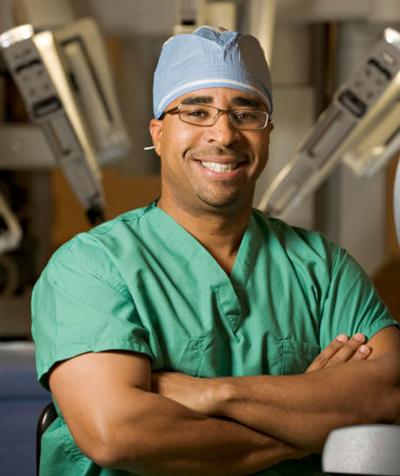

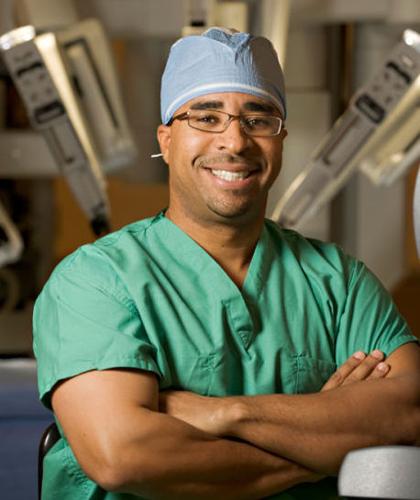
When a biopsy revealed cancerous tissues in Paul Steele’s prostate gland last year, he and his wife, Michelle, sat down with Layron Long, MD, a urologist with Samaritan Urology in Corvallis, to better understand what Paul was facing and to learn about his options.
Long outlined several treatments for Paul to consider which included: surveillance and monitoring for a year, radiation therapy, traditional surgery or a robotic-assisted prostatectomy using the da Vinci® Surgical System.
“Because prostate cancer can be slow growing, my wife and I initially thought we’d just wait and see and do surveillance and monitoring for a year,” said Paul. But like many facing a cancer diagnosis, Steele admitted that he was nervous about letting cancer grow inside of him instead of removing it immediately.
“I was a bit apprehensive about the wait and see approach,” said Paul. “So, Michelle and I researched the other options, and robotic surgery really stood out to us as the best path. That it is a minimally invasive procedure with less blood loss, less scarring and less time in the hospital made it very appealing.”
People are also reading…
According to Long, “The precision the da Vinci® affords a surgeon is another plus. During a robotic prostatectomy, the tiny cameras of the da Vinci® robot give me 10 times the magnification of the naked eye, and overall range-of-motion increases to 360 degrees. Improved sight and mobility help us preserve the nerves and blood vessels, which surround the prostate.”
The Steeles watched several robotic-assisted prostatectomy procedures online to learn more, and they also researched Long. “Between what we learned about the procedure itself and Dr. Long’s extensive background, we were very impressed. We knew robotic surgery was the right choice,” said Paul.
Steele underwent surgery a couple of months after the initial diagnosis, and was in and out of the hospital within 24 hours.
“I am very happy that I elected to have the robotic-assisted prostatectomy,” said Paul. “I can’t say enough good things about the entire experience. I had minimal pain. My recovery was fairly quick, and I felt very prepared by Dr. Long and his staff. He is an incredible physician. I am very impressed with my care.”
Today, Long often refers patients considering a robotic-assisted prostatectomy to talk with Paul about his experience.
“While I recommend the procedure, everyone needs to decide what treatment option is best for them,” said Paul. “I hope that as I talk with patients who are considering it, that I am able to answer their questions and alleviate some of their concerns. It was the right decision for me, and at six months post surgery, tests indicate no reoccurrence.”
Samaritan invested in robotic-assisted surgery in 2009 and since then the program has grown to include more physicians and available procedures. Nationwide, 90 percent of all prostate surgeries and more than half of all hysterectomies are now being performed by surgeons using a robotic platform. The 3-D imaging and precise nature of the robot allows even the most complex and delicate procedures to be completed with only very small incisions.
Patients who undergo robotic-assisted procedures with the da Vinci® system experience less pain, less blood loss, smaller incisions and fewer complications when compared to open surgery or traditional laparoscopic surgery. Additionally, patients have shorter hospital stays and resume normal activities much faster.
Providers currently using the da Vinci® Surgical System at Good Samaritan Regional Medical Center are: Paul Daskalos, DO (OB/GYN), Linda Fox, MD (OB/GYN), Jess Hickerson, MD (OB/GYN), Layron Long, MD (urology), Emily Rangel, MD (OB/GYN), and Don Yarbrough, MD (general surgery).
For more information about robotic-assisted procedures, visit samhealth.org/robotics.